
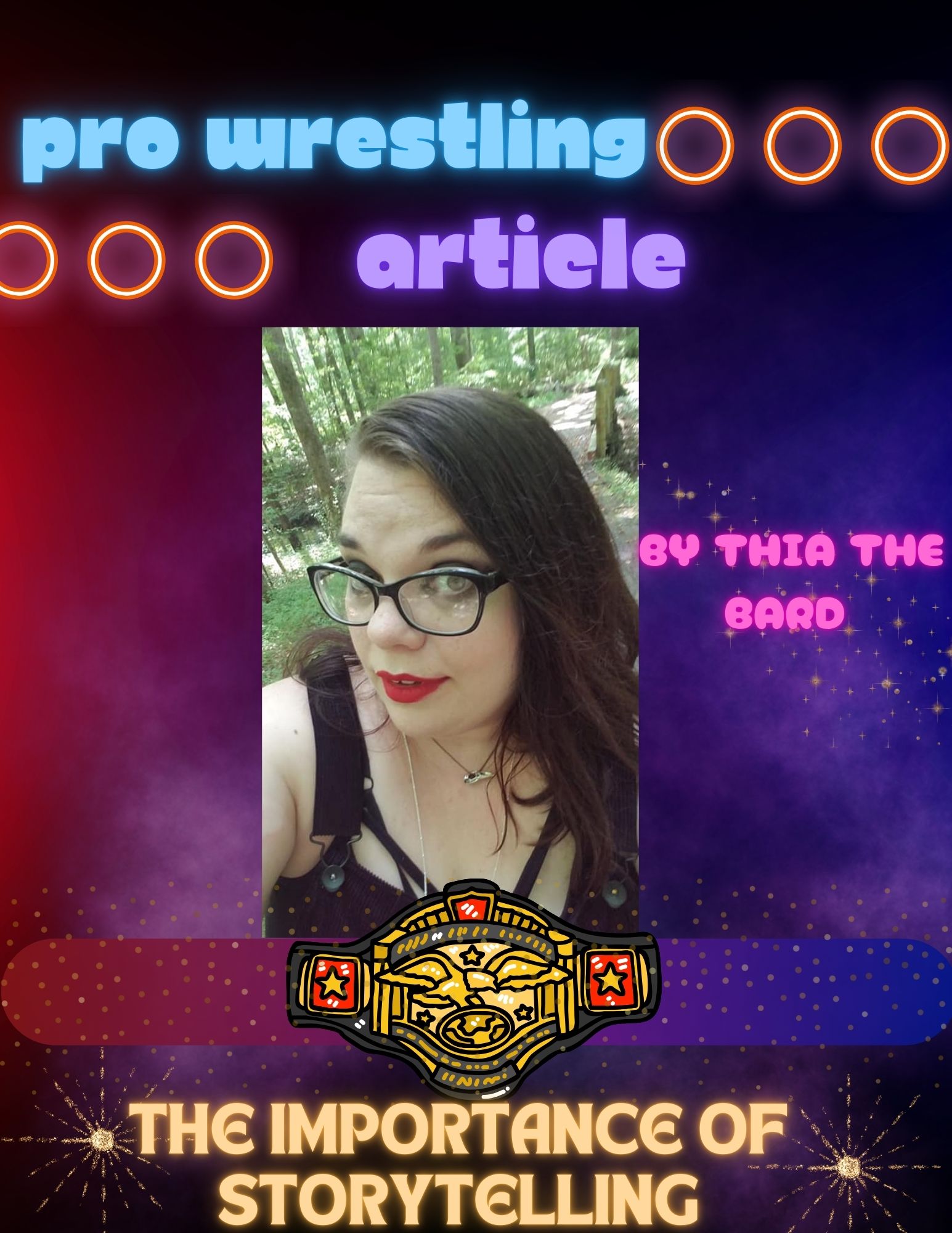
Hi there! I’m Thia the Bard and I love wrestling. I have been watching since the 1990s. Recently many members of Real Women of Gaming have been getting together to watch and it has been so much fun. It has also sparked some wonderful conversations between us. I thought it might be interesting to share some of my thoughts on different topics in wrestling.
First off, we don’t believe in fake fans here. You don’t have to like a specific promotion. You don’t have to be a lifelong fan. I’m just happy to have you here for the ride even if you are just curious about wrestling.
In this article, I specifically wanted to talk about storytelling.
Now, we first have to get this out of the way: Wrestling is not fake. The story can be scripted, the extent of which depends on the promotion and the talent involved in the match. There is, however, an overarching drama that is being told throughout the match and the show. The bumps, or when a wrestler intentionally falls or lands, are very real. The ropes hurt. The ring and the mats on the floor are not very thick (trust me I fell on one at an indie show) and they don’t give much protection for the talent.
Wrestling is the intersection of soap operas and sports. Wrestlers tell stories of what is relevant at the time. There are good guys (babyfaces, faces or technicos) and there are bad guys (heels or rudos.) They are there to tell a story.
In the ‘80s there were rich heels coming into town (e.g. “Million Dollar Man” Ted Dibiase, Iron Sheik) to take from the blue collar babyfaces (e.g. Junkyard Dog, Andre the Giant). In the ‘90s we had evil bosses, the threat of censorship, actual supernatural beings and even the fear of Y2K. Today, we have a lot of underdog stories. A scrappy wrestler who will keep trying no matter how they are held down. Women have fought for their right to be included as more than ring card girls, and have better and longer matches. LGBTQIA plus wrestlers have come out on TV and been cheered.
The matches don’t matter without the story. Don’t get me wrong, athleticism is important. The ability to perform and keep your coworkers safe is vital but at the end of the day we need a reason to cheer… or boo. Why do you deserve that belt? Why are you here to hurt people?
The story needs to resonate in some way. The fear, hopes and dreams of the audience has to be put on display. If not you won’t go far in the business.
I think it has gotten harder to tell a story in wrestling. Or at least it has become more complex. We are still worried about our families and jobs but the bad guys and the good guys aren’t as clear cut as they were in the past. There is a lot of grey area in wrestling nowadays and it is exciting to see wrestlers get to use that space for their stories.
More and more often I see sympathy for heels. I feel like most adult wrestling fans understand that two things can be true at once; yes your reasons for saying you will take apart this company are correct but no you should not be “fixing” it this way. Or so many heels are faces who have had to change in order to face a monster and now have become the monster themselves. I find this exciting.
You can’t just come out and say someone is mean and that makes you a face now. You have to have hope. Something you are fighting for. A real reason to have that belt or that big match. Or are you a former heel reluctant to take on this mantle but someone worse than you has turned up and you are the only one who can face them and save us all?
Storytelling has changed, in many ways and for many reasons. One being that we, as fans, can engage in so many more ways than before. Recently fans have taken to social media for multiple reasons and have exacted change, such as change for female wrestlers. During the Divas era of wrestling in the WWE, fans took to social media to help the women have longer matches and more meaningful storylines. Recently in AEW, the longest women’s match in its young history took place because fans have been complaining about short match times for female talent. To help Cody Rhodes finish his story and get his WrestleMania title opportunity, viewers petitioned for a huge storyline change last year. For better or for worse we fans have multiple platforms now and are unafraid to use them.
Long term story telling has been a tool that many companies have been taking advantage of recently. WWE has years worth of moments from talents like The Bloodline, Kevin Owens, Sami Zayn and Rhea Ripley. AEW has only recently been telling stories with the Death Riders, Timeless Toni Storm and a crazy feud between Adam Cole and MFJ but we hope they have many more years to come.
From the start of professional wrestling till now though, one thing rings true. The story has to make sense and it has to touch people in some way. That is why fans are so invested. We have had years of stories to look back on. So when you give us a hopeful optimist and make them lose the big matches over and over again it affects the story. What’s the point? If you have a wrestler who holds a belt for years and they never lose a big match then what is the point? The first will never win and the later will never lose. There are no stakes in the story.
Without stakes, why should I be interested? Without a good story why should I care? All the cool flips, grips and throws in the world can’t keep fans if the story is lackluster.
There it is. A short and simple article on storytelling in wrestling.
What do you think? Do you have a favorite storyline? One that you have hated? Let us know in the comments below.
ALWAYS KEEP SPARKLING!!!

 Real Women of Gaming
Leave a comment