
This article was originally posted on Phoenix’s substack found here.
Digital Porch Theory (DPT) is a term that my bestie, Muzicchik, and I came up with. We’ve used this term for a little over a year now to explain how we see the internet and navigate social media. We both fall into the elder millennial category so we are part of the demographic that not only navigated this online space for a long time, but also among the billions of people who helped create its culture. The internet, particularly when it comes to social media, is at its most basic a communication tool. A very powerful communication tool: many have fought and continue to fight to have control over it. Yes, the internet can be a deeply despondent place, but it can also be a bright, enlightening tool that helps people and causes real change, because when we talk and listen to each other we grow closer and make better decisions for all involved.
We need to establish etiquette rules online because it’s something that has rarely been discussed. The internet has always been seen as a not “real” or tangible thing. I mean, how often do we use the phrase “real life” or “IRL”? The thing is, it is real life, with real life consequences. My goal here is to illustrate why communication has become so hostile, especially on social media, and to propose a general set of rules to consider when navigating online spaces. My hope in this article is that we can come to a more healthy way of connecting, both on and offline.
The internet has always been seen as a “not real” or tangible thing. I mean how often do we use the phrase “real life” or “IRL”? The thing is, it is real life with real life consequences.
Phoenix
The foundation of DPT is communication. We all know that communication is simply the transferring of information. Reading this article is a form of communication, just as much as a date to get to know a new potential partner. It doesn’t matter what the information is: our likes and dislikes, or the nuclear codes. Not all communication is good, and it’s our job to critically consider the information that comes to us. If you’d like to dig deeper on that subject, check out my colleague Trae’s article on misinformation in modern journalism
The internet and digital world have often been considered the “wild west” because its still relatively a free-for-all as far as legislation – which is always slow to catch on in regards to social issues. There are few protections and those vary state by state, and none are federal. For example, AI is a huge issue right now with tech companies pushing this tech into every market. We’ve seen the dangers AI poses from creating fake content of others to telling people to “unalive” themselves. We can no longer pretend that whatever happens online stays online because it doesn’t. So what? Why does it matter? It matters because we all live in this world together. The internet opened the globe. We no longer take days, weeks, months, or years to get information from outside of our own little bubbles; we can know what’s happening in an instant. Even though it’s the world wide web, the USA has used the internet to silo us and separate us from the rest of the world. The difference is they can’t hide everything like before because the internet cannot and should not be controlled. What can be controlled is our interactions and how we choose to behave online. We control how we use communication to express ourselves. We can make the choice to answer the phone when someone calls, or choose not to. Even when someone is physically in front of us, we don’t have to participate in that conversation. We can simply walk away.
What can be controlled is our interactions and how we choose to behave online. We control how we use communication to express ourselves.
Phoenix
As we continue to grow and understand ourselves individually and as a species, our ability to express ourselves has also expanded. However, for any species to sustain itself we have to do what’s best for the collective, not the individual. So we communicate our needs to each other and ideally come to a solution that works for everyone. Unfortunately, in the USA, we idolize the idea of the American Dream – also referred to as the nuclear family. We were sold the idea of a neat tidy family package as the ideal of success; 2.5 kids, a dog, cat, house, car, and a white picket fence. The reality that has played out with this idolized version of America is that it creates small isolated family units and discourages community. This leads to a more individualistic view of society and helps continue propping up the foundation of white supremacy culture that is the United States of America. I highly recommend reading “Caste” by Isabel Wilkerson or watch the movie about the book by Ava DuVernay, “Origin.” Wilkerson’s book is a great deep-dive into the foundation of America.
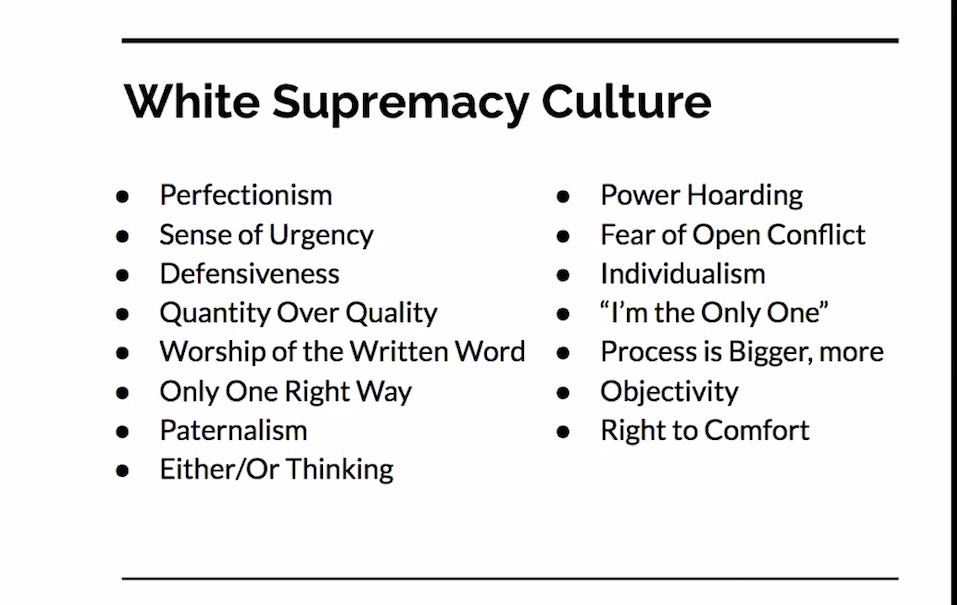
American society has determined that if we can’t achieve this “American Dream” we are failures and leave no room for a different view of success. It completely removes the village from the family dynamic, which isolates us from one another because not all families look the same nor do they function the same. We need to re-frame how we look at the world as Americans, especially white America. It is very difficult to go through life and not affect those around us; even if we’re just NPCs in another person’s story, our actions still affect them. We – white America – have allowed ourselves to get to a point where we exist on autopilot because the culture we live in is set up to benefit us. This type of mindset leads to entitlement, selfishness, and narcissism.
White supremacy culture puts blinders on white America to the oppression that our country is founded on, but we can change that. One of the biggest things we can do is stop assuming everything is about us individually. Especially online. What I mean by this is that we have to de-center ourselves when listening to marginalized folks sharing their stories. Historically, as a demographic, we have spent plenty of time talking and forcing our views on everyone else. It’s time for us to start listening and supporting. We have to be intentional with how we interact with the world.
This brings me back to Digital Porch Theory and why I feel it’s important. This theory, to reiterate, is to help establish guidelines in how to interact online and it’s really not that different from how we act offline. Think of social media as a massive street or neighborhood. When we go on a walk around our neighborhood, we get to see how folks decorate their houses and porches. Sometimes we’ll like the décor, sometimes we won’t. What do we do if a neighbor has some décor we don’t like? The reasonable thing is to just ignore it because it really doesn’t affect us. So why can’t we carry that idea over to the online space? Our accounts on these platforms, Tiktok, Bluesky, Threads, Facebook, etc, are essentially a digital “porch,” because our online presence is an extension of ourselves. Not all of ourselves–just a portion, similar to what we see on our physical porches. We choose what is seen but it still doesn’t show all that is in our house. There is research that “showed that not only do people consider how much they disclose, but what they disclose and the way in which they share it.” The concept of context collapse comes up a lot in this discussion – also referred to as the bean soup theory. Essentially DPT is a practice we can use to avoid this context collapse if we learn to sit back and process; remembering that not everything is for us or about us.
If people stopped at every porch or patio that had a conversation going on or decorations we don’t like as often as we do on social media, we’d be in the hospital from all the ass whoopings we’d be given. We see the excuse of “it’s public so I have a right.” Yes, but so is our front porch and we don’t just walk up on those unannounced expecting kindness, do we? Look at how many white people pull a gun immediately before asking questions. People are too trigger happy. So if we want to navigate this space it requires some deep self reflection and some understanding that abuse online is just as bad as abuse offline. We have to stop excusing it and call it out for what it is, and when we do it ourselves we need to sit and reflect. We are in a digital renaissance era and the internet is here to stay, so let’s determine how it influences the world. Do we want to leave it with AI, technocrats, and hateful people, or do we want to leave behind amazing art, community, and love?
We are in a digital renaissance era and the internet is here to stay so, let’s determine how it influences the world. Do we want to leave it with AI, technocrats, and hateful people, or do we want to leave behind amazing art, community, and love
Phoenix
What does this look like?
First – Determine: are you decorating your own porch or are you visiting someone else?
Second – On your porch you can use the block button or hear out the comments. It’s your porch so you get the control. Just be aware as a white person you occasionally will get a call in, or out, if you post some outrageous things. Visiting a porch? Next step.
Third – Take the time to process what you are reading. The following suggestions are useful for visiting and for visitors, but it’s most important for white people when conversing with the global majority online.
Is this about me?
1. STOP and assess your feelings before responding or commenting, especially if it creates a knee-jerk reaction. Sit in that feeling and figure out why the comment or post made you feel that way.
2. Determine if your feelings are justified. They are valid, but does this comment/post actually need you to respond?
3. If you determine a response is needed, DO NOT post it. READ it again before hitting send. Ask yourself, “Is this centering me?” Are you using anecdotal experience to add to the discussion or are you just talking about yourself? This step requires you to be self-reflective.
4. If you get a response repeat steps 1-3. At some point you will realize neither of you are listening to each other and you’re just circling around a boxing ring waiting for someone to throw the first punch. We don’t want this. This does not create meaningful discussion and communication. All of this requires us to be cognizant of ourselves; the good, the bad, and the ugly.
5. If you’ve done all this and have had what you think is a substantial discussion but someone continues to attack you, go ahead and block them. These are not hard and fast rules; they’re just suggestions to help us be more aware of our actions and how they affect those around us, while also keeping true to our own boundaries. Remember: you don’t have to engage. It is a choice.
Decorate your digital porch how you like, and block liberally. Be open and willing to listen to other perspectives. Apologize when it’s needed. There will always be bad actors, so don’t let them ruin your time while you are here. They’re not worth it, and when visiting other people’s spaces remember to be kind and use this process; your experience will be much more positive and yield healthier communication, not just online but offline as well.
 Real Women of Gaming
Leave a comment