
What happens when a game creator who loves old horror movies, VHS technology, TTRPGs, and board games is allowed to craft their ideal game? You get Very Horror Stories (VHS). The game really is a mixture of all those things, with a whole lot of passion for their craft.
The game itself started from a single Kickstarter. Keeping the momentum going from that success, it spawned a sequel, many digital-only products, a second print via a new Kickstarter, and one third print, this time using the “Return of the Living Dead” license.
Where Do We Start?
There are two ways to get into VHS: the Quickstart rules or one of the six themed VHS tapes. Each tape has roughly the same contents — The VHS rules, the specific rules for running the films in that VHS tape, a host of tokens, maps, and sheets for both protaganists and antagonists.
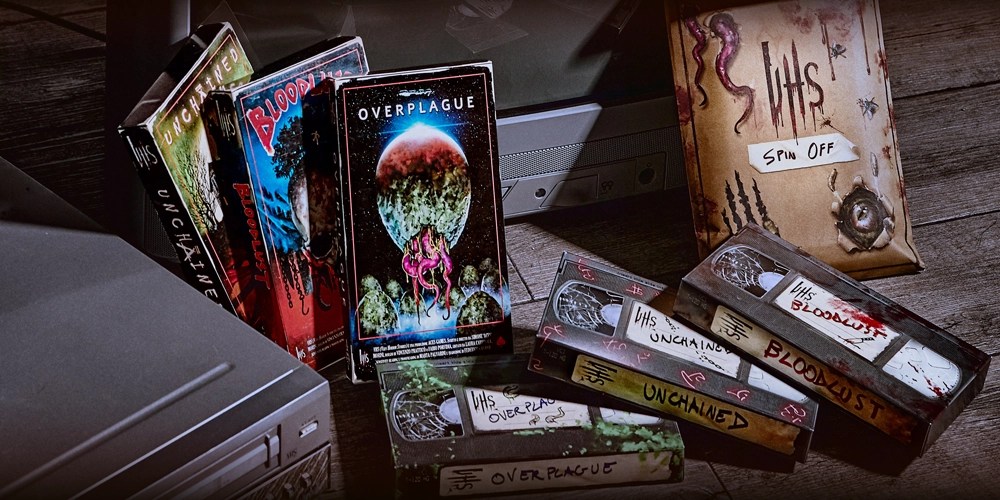
The six VHS tapes are Bloodlust, Overplague, Unchained, Deadbreak, Remnants, and Trashbag, each corresponding to a different play style. The first three made up the original kickstarter, and each contains 10 pre-made films. The second three made up the sequel kickstarter and each contains 5 pre-made films.
The films of Bloodlust connect to slasher films, while Overplague targets the science fiction corners of horror. Unchained deals with the dangers of supernatural horror. Deadbreak (and the “Return of the Living Dead”) deals with zombie films, while Remnants looks at the ghostly non-corporeal undead. Finally Trashbag is a catch all that scratches the B-Movie itch.
What Is It Like?
Half-boardgame and half-RPG, the films can be played with or without a Gamemaster (called the “Director” in VHS) found in other RPGS. Any film marked “Solo” can be played in this fashion, while those without the designation need a Director.
First, the game board is setup according to the “Production Notes”. These list of the monsters that will be present, the “side-sets” that are the points of interest found on the map, as well as any notable tags that change how the film functions. For example, two films could both use the same swamp map, but one might have a tag denoting a riverbed is dried out, while the other has it flowing freely and dangerously.
The players will each pick a protagonist (rules exist for crafting your own, but the first few films should be played with pre-made characters) and, after a short introduction, they’re let into the world on their own. The rules provide the framework for performing actions (both predefined and those that the players might improvise), and exploring. Once each player has had a chance to do both, a Tension Roll triggers, which ramps up the danger as the movie plays out.
Characters are relatively simple, with four abilities numbered 5-9. To succeed on a check of any sort, the player simply rolls two six sided dice, and if the result is equal to or lower than their ability, it is a success. Characters also possess four traits to give each some unique abilities that change up how things typically play out. An example might be “If the monster appears and you are alone, you act first.”
The monster also has four abilities, traits, and special abilities like the characters do. Under the supervision of the director, or following the behavior flowchart found in the rules, the players will not know when or where they will see the monster, only the Tension roll can determine that. If the players moved quickly, or took time to search for items, it’s more likely the Tension roll will end badly for the players.
With VHS playing out in this way like a roleplaying game, players and the Director are encouraged to roleplay, to chat, and to try and make this feel as much like a movie as possible. Where the game departs from traditional TTRPGs is the requirement for the map (called a “Set”), divided up into many segments.
These segments could contain clues on how to defeat evil, evidence of their corruption, tools to help the characters, or non-player characters of both the helpful and unhelpful types. Non-Player Actors are your extras: the farmers, cops, and doctors of the world. “Horrors” are the secondary monsters that are present, and both of these NPAs function like the Players or Monster, except that they have reduced mechanical complexity.
Each game should last about an hour and a half, although there are some quick-play rules for some “Short Films.” Characters are more likely than not to die, so special rules for the “Final Girl” (or “Final Boy” or “Final Stand”) exist, boosting their abilities so that JUST MAYBE, evil can be buried once again.
Who Is This For?
If you’re a lover of horror films and of RPGs, this game is for you. A few questions you might ask yourself when looking at buying VHS: Very Horror Stories — “Why would you choose this over a board game?”, “Why would you choose this over an RPG?” and “Where should you start?”
The answers for the first and second questions are the same: it’s not quite a board game and it’s not quite an RPG. There’s more freedom and agency than a board game, and there’s a more definitive goal than an RPG. There is the benefit of expectation: this is a movie. It has a start, a middle, and an end. While your characters CAN play many films, there’s no expectation of a campaign here.
What many groups might find difficult is running the game solo. The game is best played with a director to add unpredictability and to keep the tension and atmosphere going. That’s not to say the solo rules are bad, they don’t do the game a service.
Everything Else Of Note!
The game itself comes in both physical and digital versions, but it is designed to be played with the sets and tokens in mind. If you plan on playing digitally, prepare to use a virtual table top.
Since the original Kickstarter, a common complaint was that everything was in the manuals and organization is poor. Even if you buy the physical versions of the VHS tapes, learning the game is easier when you download the quick-start rules because they have much better organization. The index especially is useful, condensing a 100 page book into about 17 pages.
Finally, there are some “extra” packs outside of the six VHS tapes. These can be used on their own, but do not have the same themes as found in the tapes. It’s recommended to get the tapes first and expand your content with these collections.
 Real Women of Gaming
Leave a comment